Auroralumina attenboroughii and other Attenboroughs
22nd August 2022
Many of you will have seen the recent news that a newly discovered fossil of the ‘earliest animal predator’ will be named Auroralumina attenboroughii after our very own patron, Sir David Attenborough.
Well we thought we would take the opportunity to look at some of the other species that have also been named after the man who has inspired so many of us to join the conservation movement.
Celebrating Sir David’s history of introducing generations of radio and television audiences to the remarkable lives of numerous species, researchers have named over 15 species for him; an honour, Sir David has said, that represents one of the ‘biggest of compliments that you could ask from any scientific community’.
Two are critically endangered. Attenborough’s Pitcher Plant Nepenthes attenboroughii, which is confined to Mount Victoria, Palawan, in the Philippines, and Sir David’s or Attenborough’s Long-beaked Echidna Zaglossus attenboroughi, only known from the Cyclops Mountains in Papua New Guinea.
The Nepenthes attenboroughii pitcher plant – a carnivorous plant endemic to the Philippines – is particularly significant for CCI as Sir David chose this species to ‘overwrite’ in 2018 for ‘Seeing Red.. Overdrawn’ a participatory artwork created by artists Ackroyd & Harvey with the support of the CCI Arts, Science and Conservation Programme.
Georgina Mayhew, from CCI said ‘I was privileged enough to ‘supervise’ David writing over the pitcher plant species, and distinctly remember when I passed him the white cloth gloves that everyone had to wear to protect the artwork, he said to me “Ah, it gives it a sense of occasion!”. It’s a memory I will always treasure.’

All the authors of papers describing these species cite Sir David’s influence on their early lives as naturalists, and their admiration for his books and films. Typical of the citations include that by Thomas Courveur and Raoul Niangadouma in describing Sirdavidia, ‘We dedicate this new genus to Sir David Attenborough, British broad-caster and naturalist, in honour of his lifelong dedication to nature, conservation, evolution and natural history programs. His passion for nature has influenced and inspired a generation of biologists and naturalists, including the first and senior authors of this paper’.
It is safe to say that there are hoards of people in the David Attenborough Building who feels the same!
A few other favourites named after Sir David;
Microleo attenboroughi – a ‘kitten-sized’ marsupial lion a fossil specimen believed to be 19 million years old found in Australia and named after Sir David in 2016
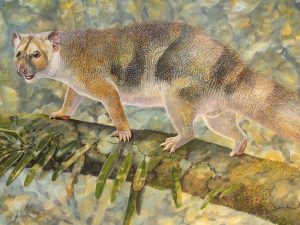
– Reconstruction by palaeoartist Peter Schouten of Microleo attenboroughi prowling along the branches of rainforest trees in search of prey. Image credit: Peter Schouten
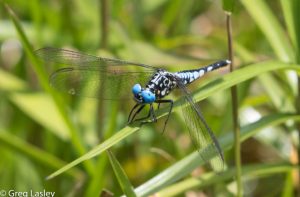
Acisoma attenboroughi dragonfly also known as Attenborough’s pintail found only on the island of Madagascar
Our very own David Attenborough Building!